
- You are here:
- Home
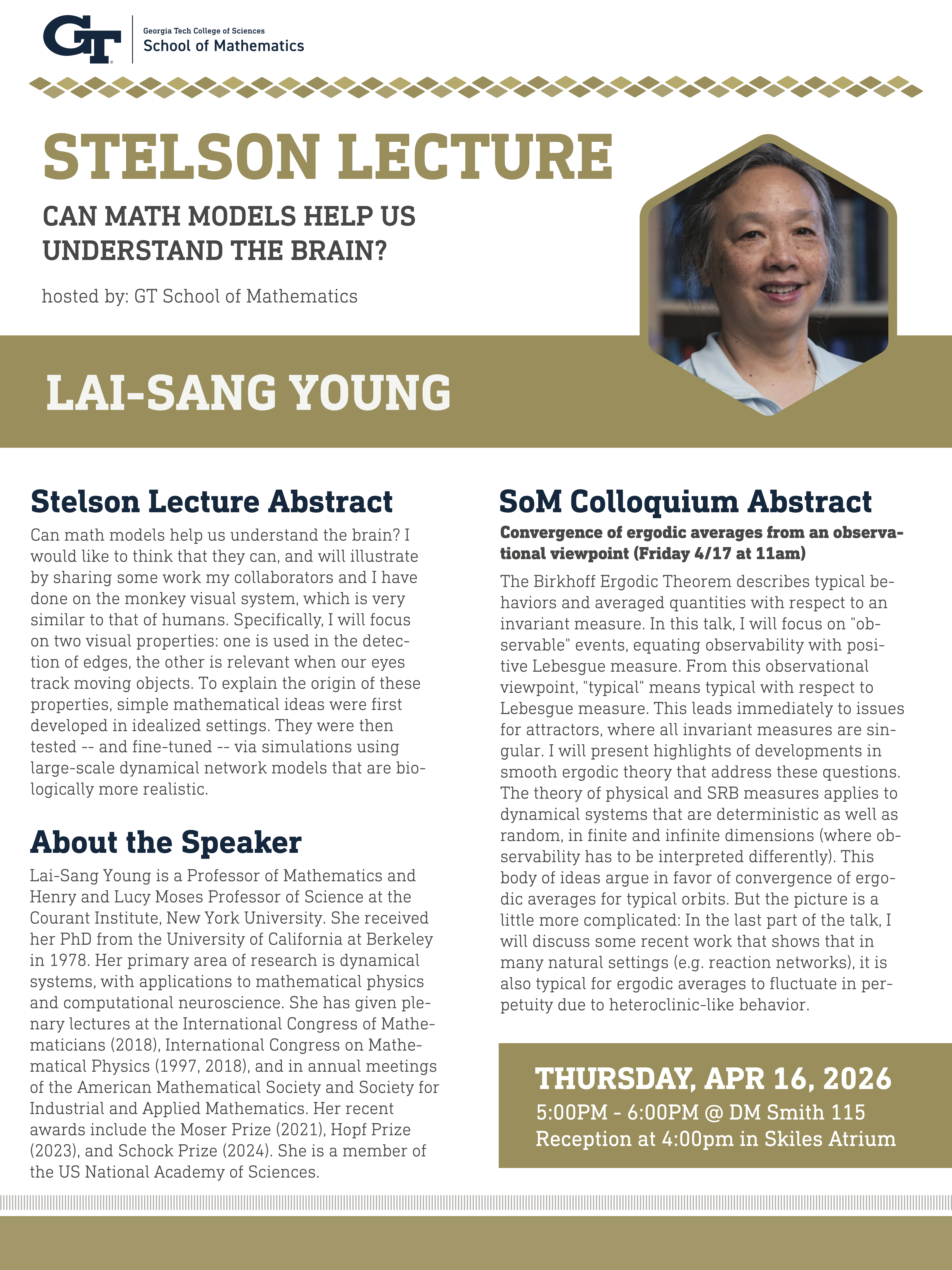
Professor Lai-Sang Young will give the Spring 2026 Stelson Lecture, hosted by the School of Mathematics.
Can math models help us understand the brain?
Thursday, April 16, 2026
5:00PM - 6:00PM @ DM Smith 115
Reception at 4:00pm in Skiles Atrium
Stelson Lecture Abstract
Can math models help us understand the brain? I would like to think that they can, and will illustrate by sharing some work my collaborators and I have done on the monkey visual system, which is very similar to that of humans. Specifically, I will focus on two visual properties: one is used in the detection of edges, the other is relevant when our eyes track moving objects. To explain the origin of these properties, simple mathematical ideas were first developed in idealized settings. They were then tested -- and fine-tuned -- via simulations using large-scale dynamical network models that are biologically more realistic.
SoM Colloquium Abstract
Convergence of ergodic averages from an observational viewpoint (Friday 4/17 at 11am)
The Birkhoff Ergodic Theorem describes typical behaviors and averaged quantities with respect to an invariant measure. In this talk, I will focus on "observable" events, equating observability with positive Lebesgue measure. From this observational viewpoint, "typical" means typical with respect to Lebesgue measure. This leads immediately to issues for attractors, where all invariant measures are singular. I will present highlights of developments in smooth ergodic theory that address these questions. The theory of physical and SRB measures applies to dynamical systems that are deterministic as well as random, in finite and infinite dimensions (where observability has to be interpreted differently). This body of ideas argue in favor of convergence of ergodic averages for typical orbits. But the picture is a little more complicated: In the last part of the talk, I will discuss some recent work that shows that in many natural settings (e.g. reaction networks), it is also typical for ergodic averages to fluctuate in perpetuity due to heteroclinic-like behavior.
About the Speaker
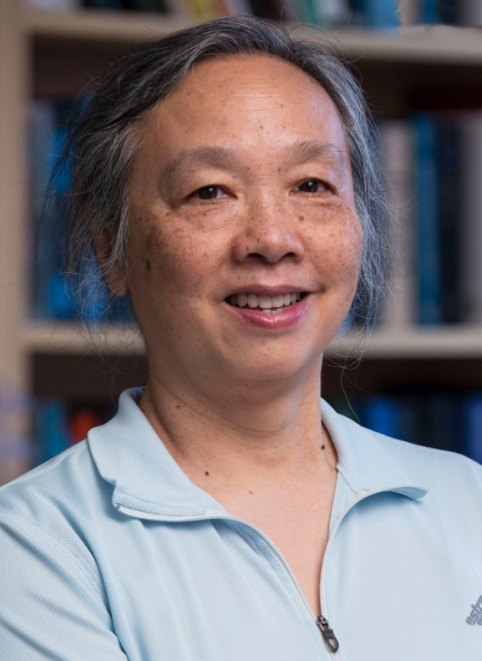
Lai-Sang Young is a Professor of Mathematics and Henry and Lucy Moses Professor of Science at the Courant Institute, New York University. She received her PhD from the University of California at Berkeley in 1978. Her primary area of research is dynamical systems, with applications to mathematical physics and computational neuroscience. She has given plenary lectures at the International Congress of Mathematicians (2018), International Congress on Mathematical Physics (1997, 2018), and in annual meetings of the American Mathematical Society and Society for Industrial and Applied Mathematics. Her recent awards include the Moser Prize (2021), Hopf Prize (2023), and Schock Prize (2024). She is a member of the US National Academy of Sciences.
Event Details
Date/Time:
-
Thursday, April 16, 2026 - 5:00pm to 6:00pm
Location:
DM Smith 115
Related Media
StelsonLecturePoster_young_18x24.png
headshot_young_for_stelson.png